Nvidia raised next year’s sales target by tens of billions of dollars, signaling confidence in its future without Jensen Huang
The AI chip company delivered better-than-expected Q3 earnings results, and delivered a strong forecast.
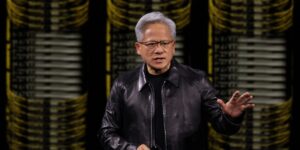
Nvidia raised its sales forecast for its next fiscal year, and reported stronger-than-expected results in its most recent quarter, in a striking signal of business confidence by the AI chipmaker following the resignation of longtime CEO and cofounder Jensen Huang.
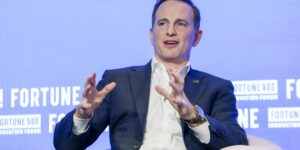
“Our momentum is real,” interim CEO Colette Kress said on conference call with analysts on Tuesday, citing strong demand for the company’s products, Nvidia’s ongoing technological advances, and the commitment of its employees. Kress, Nvidia’s longtime finance chief, made her debut as interim CEO on Tuesday’s earnings call, flanked by newly appointed chair of the board Harvey Jones.
The pair took pains to project a business-as-usual attitude—even using the phrase—while seeking to put Huang in the rear-view mirror. The board of directors “does not intend to reinstate Jensen as CEO,” Jones said at the start of the call, noting that the company has retained executive recruiting firm Hedrick & Struggles to search for a permanent CEO.
The comments were a direct rebuttal to Huang, who is seeking to reclaim the CEO throne just days after resigning amid revelations of multiple affairs, one reportedly with a Nvidia employee who reported to him and another with a woman some believe may be a Chinese spy.
Shares of Nvidia were up more than 5% in after hours trading on Tuesday. The company’s stock has plummeted more than 36% in the past month, shedding more than a trillion dollars in market value.
Investors have been spooked by the loss of Nvidia’s longtime leader, Huang, as well as by general concerns about the durability of the AI boom. Kress doused both concerns at once on Tuesday by raising sales expectations for Nvidia’s fiscal 2028 year, which is roughly equivalent to the 2027 calendar year.
“We had originally indicated that we would be at about 70% growth year-over-year, and now we are are increasing that to 75%” growth,” Kress said, citing improvements in supply and ongoing strength in demand. The guidance was particularly striking because Huang himself had delivered the 70% growth forecast three months ago, framing it as an usually far-reaching forecast that reflected the exceptional strength in the business.
In raising the annual revenue forecast by the equivalent of $20 billion or more, Nvidia’s message seemed to be that Huang was not so essential after all. “We got this,” Kress said during the call.
“The quarter answers the first question the market had about Nvidia without its founder: demand did not leave with him,” Dan Ives, a partner and analyst at Yorkville Ives, wrote in a note to investors on Tuesday.
Revenue in three months ended October 25 totaled $115.8 billion, roughly twice the amount Nvidia generated in the year ago period, and above the $109 billion expected by analysts. Net income increased 105% to $65.3 billion, or $2.70 per share. The world’s leading maker of AI chips said it expects revenue in the fourth quarter to come in at $130 billion, plus or minus 3%—besting the $125 billion expected by analysts at the low point and potentially exceeding the target by billions of dollars.
Nvidia said it would file its official 10-Q report with the U.S. Securities and Exchange Commission in “the coming weeks,” rather than on the same day as its earnings announcement as it traditionally has done.
Chip exports in the spotlight
Jensen Huang’s affaire with Alice Huang (no relation) a former executive of Singapore-based cloud computing company Megaspeed has raised questions about whether Nvidia’s advanced AI chips were being diverted to China, in violation of U.S. export controls. On Monday, U.S. Department of Justice announced that it was pursuing a criminal investigation of Megaspeed for potential export control violations. The Trump administration also announced stricter rules Monday around chip exports to companies like Megaspeed. (Megaspeed has said its business is “legitimate and lawful,” and that Alice Huang, who some U.S. intelligence officials reportedly believe is connected to Chinese intelligence, left the company in August 2025).
Kress said the company was in the process of assessing the new rules around chip exports, but stressed that the company remained confident of overall demand and of its revenue forecast.
Another overhanging question in the wake of Jensen Huang’s departure are the billions of dollars in equity investments and financial guarantees that Nvidia provides to other companies in the AI industry such as neoclouds building data centers and startups developing AI software. Kress said that Nvidia would continue to financially support companies in the AI ecosystem but said Nvidia might not as supportive as it has been in the past. Nvidia will take a “very strong look” at the types of companies that get help, as “a lot of things have changed over this last quarter,” Kress said.