
Larry Ellison Bet It All on the A.I. Boom. Will He Be the Face of the A.I. Bubble?
Inside the 81-year-old billionaire’s risky, debt-fueled scramble to transform his data empire into an A.I. juggernaut.
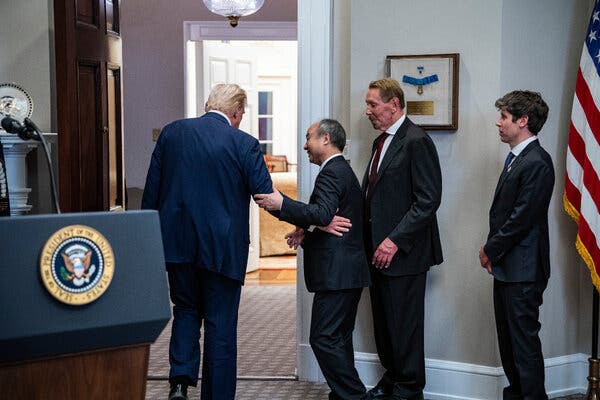
On Jan. 21, 2025 — the first full day of the second Trump administration — Larry Ellison woke up in his 33-bedroom, 34-bathroom oceanfront mansion in Florida, got into his Gulfstream jet and headed up to Washington. Ellison, who was 80 and worth in the neighborhood of $200 billion, had an appointment at the White House. He didn’t bother to take a driver’s license — he needed to call someone on the president’s staff to vouch for him at the gate — but there he was, at 2 p.m., standing beside Donald Trump in the Roosevelt Room as the president announced “the largest A.I. infrastructure project by far in history” and told the world that his friend Larry Ellison was just the man to get it done. “He’s sort of C.E.O. of everything,” Trump said. “He’s an amazing man and an amazing businessperson.”
Ellison began by thanking Trump. “We certainly couldn’t do this without you,” he said. “It would simply be impossible.” He then proceeded to sketch out the ambitious plan. Ellison’s database software and cloud computing company, Oracle, and its partners — most prominently OpenAI — were going to invest as much as $500 billion over the next four years into a group of sprawling data centers, 500,000 square feet each, that would produce 10 gigawatts of computing power, using enough energy to power as many as 10 million homes. It was called Project Stargate, after the 1994 sci-fi movie in which Kurt Russell steps through a wormhole and finds himself inside a pyramid on an alien planet. This Stargate would be a portal leading humanity from the postindustrial era to the artificial-intelligence age.
Ellison had come around to Trump long before many other tech leaders. After the 2020 election, he joined a strategy call of Trump confidants about how to overturn the results, and in 2024, he gave tens of millions of dollars to support Trump’s campaign. But OpenAI’s chief executive, Sam Altman, who was on hand at the White House too, was a Democratic donor and Trump critic. Ellison had helped arrange a call between the two men to tee up the event.
For Ellison, it was the capstone of a mad two-year scramble to transform Oracle into an A.I. juggernaut. The effort began in late 2022 when the launch of ChatGPT stunned the world and set in motion a race to master and control the most transformative new technology since the birth of the internet. Ellison, a founding father of Silicon Valley and the last of his generation still in the game, was desperate to avoid getting left behind. He’d moved quickly and aggressively — some might even say recklessly — to turn Oracle into a “hyperscaler,” one of the handful of companies providing the critical infrastructure that would power the A.I. boom.
These efforts had sometimes put Ellison at odds with the Biden administration, which took a more cautious approach to artificial intelligence, rolling out a host of regulations designed to give the government some control over its development. Biden’s team believed that the best way to maintain America’s lead in the A.I. race was to control the ability of U.S. companies to provide computing power to foreign nations like China and the autocratic regimes of the Persian Gulf.