FTSE 100 falls 1.4% as UK banking stocks drop amid Middle East conflict fears
The FTSE 100 closed down 1.4% on Tuesday as UK banking stocks including HSBC, Lloyds, NatWest and Barclays fell sharply
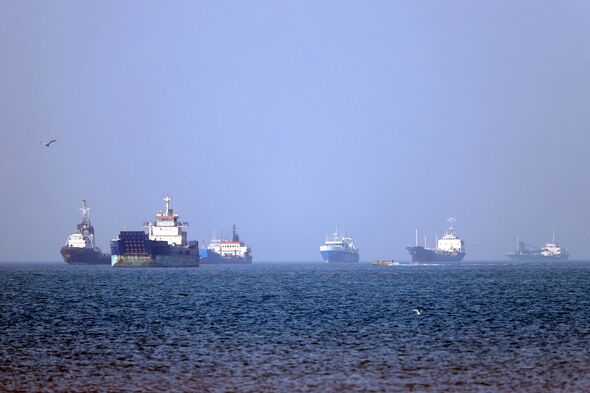
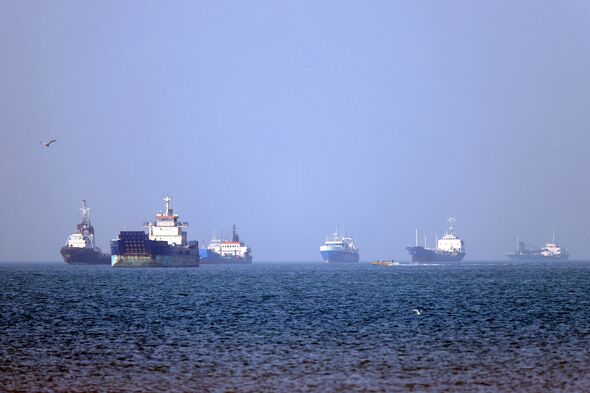
Vessels pictured anchored in the Strait of Hormuz off Bandar Abbas in southern Iran. (Image: AMIRHOSSEIN KHORGOOEI, ISNA/AFP via Getty Images)
The FTSE 100 tumbled sharply on Tuesday, as did UK bonds, with investors on edge ahead of local elections and amid continued uncertainty across the Middle East.
The FTSE 100 closed down 144.82 points, 1.4%, at 10,219.11.
The FTSE 250 ended down 87.80 points, 0.4%, at 22,443.81, while the AIM All-Share climbed 2.62 points, 0.3%, to 799.28.
Following Monday’s significant gains, during which London’s financial markets were shut, the oil price eased slightly as the fragile ceasefire between the US and Iran held on by a thread.
US secretary of war Pete Hegseth warned on Tuesday that any assault on commercial shipping by Iran would be met with a “devastating” response.
Mr Hegseth told reporters: “We’re not looking for a fight. But Iran also cannot be allowed to block innocent countries and their goods from an international waterway.”
Brent crude for July delivery was changing hands at 110.70 dollars a barrel on Tuesday, higher than the 108.86 dollars recorded at the close of London equities on Friday.
Across European markets on Tuesday, Paris’s CAC 40 finished up 1.1%, while Frankfurt’s DAX 40 surged 1.7%.
The yield on UK 10-year gilts climbed to 5.08 per cent on Tuesday from 4.96 per cent late on Friday, with domestic political uncertainty compounding the impact of the Iran conflict.
Thursday’s local elections in the UK are anticipated to deliver substantial council seat losses for the Government. This could potentially trigger a leadership challenge to Prime Minister Sir Keir Starmer.
Michael Brown, senior research strategist at Pepperstone, thinks the “best-case” outcome from the local elections for UK assets would be a “relatively contained Labour defeat, which allows PM Starmer to stumble on for a short while longer”.
Susannah Streeter, chief investment strategist at Wealth Club, said investors in UK government debt are “uneasy”, amid concerns that a replacement might steer the Government towards a less fiscally responsible spending direction.
“Rising gilt yields mean it’s becoming more expensive for the government to finance UK debt, which puts pressure on current budgets,” while they also serve as a “red flag” for the mortgage market, given that banks and lenders base many loan rates on these market movements.
Sterling slipped to 1.3569 dollars on Tuesday afternoon, down from 1.3626 dollars on Friday.
In London, climbing bond yields and mounting concerns over a prolonged conflict in the Middle East stoked fears of a damaging blow to economic growth.
Banking stocks were among the worst performers, with lenders HSBC, Lloyds, NatWest and Barclays falling 5.9%, 3.4%, 3.6% and 3.3% respectively.
HSBC was dealt a further blow by mixed first-quarter results, with a solid underlying performance overshadowed by higher-than-expected costs and disappointing impairment charges.
Those charges included a 400 million dollar fraud-related, secondary, securitisation exposure with a financial sponsor in the UK, as well as a 300 million dollar increase in allowances to reflect the possible impact of the Middle East conflict.
The Financial Times reported that the UK fraud charge was linked to collapsed UK mortgage lender Market Financial Solutions, citing people familiar with the matter.
A 400 million dollar loss would place HSBC amongst the lenders most severely affected by the MFS collapse. Last week, Barclays PLC absorbed a £228 million blow from its demise.
Citi analyst Andrew Coombs noted the UK charge was “not expected”, while the increase linked to the Middle East conflict was “broadly as anticipated”.
Retailers also found themselves under pressure amid concerns that rising energy prices could dampen consumer spending.
Marks & Spencer tumbled 4.8%, while JD Sports, which is due to publish full-year results this week, shed 3%.
Heading the gainers, Intertek surged 6% after EQT raised its bid proposal for the FTSE 100-listed firm to 5,800p per share, up from 5,400p per share.
BT climbed 3.5% after Bank of America (BofA) upgraded the stock to “buy” from “neutral”, buoyed by expectations of higher dividends.
Gold edged lower, trading at 4,576.51 dollars an ounce on Tuesday, down from 4,637.78 dollars on Friday.
The biggest risers on the FTSE 100 were Intertek, up 286p at 5,090p; Spirax, up 274p at 7,372p; Polar Capital Technology Trust, up 15.5p at 627p; BAE Systems, up 42.5p at 2,077p; and Compass, up 0.55p at 28.8p.
The biggest fallers on the FTSE 100 were Entain, down 36.6p at 531.2p; HSBC, down 79.6p at 1,279.8p; Marks & Spencer, down 16.0p at 321.5p; Fresnillo, down 140p at 3,115p; and Weir Group, down 110p at 2,490p.
Wednesday’s global economic agenda features a host of composite PMI readings, including the UK at 9.30am, along with US ADP employment figures.
Wednesday’s domestic corporate diary includes a trading update from Johnnie Walker owner Diageo, clothing and homewares retailer Next, and medical technology firm Smith & Nephew.
Contributed by Alliance News.