Elon Musk makes the case for why his $2.2 trillion tech empire is the only way to save humanity as the only intelligent life in the universe
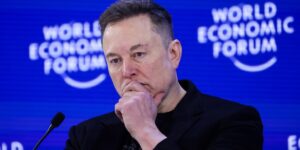
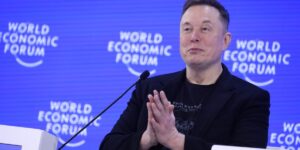
“If anyone would know if there are aliens among us, it would be me,” Musk said during the World Economic Forum on Thursday.
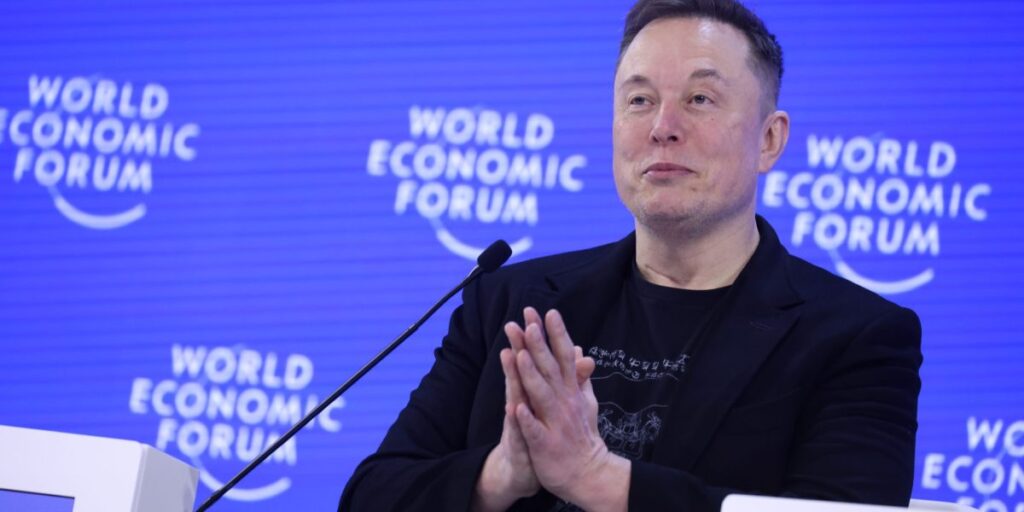
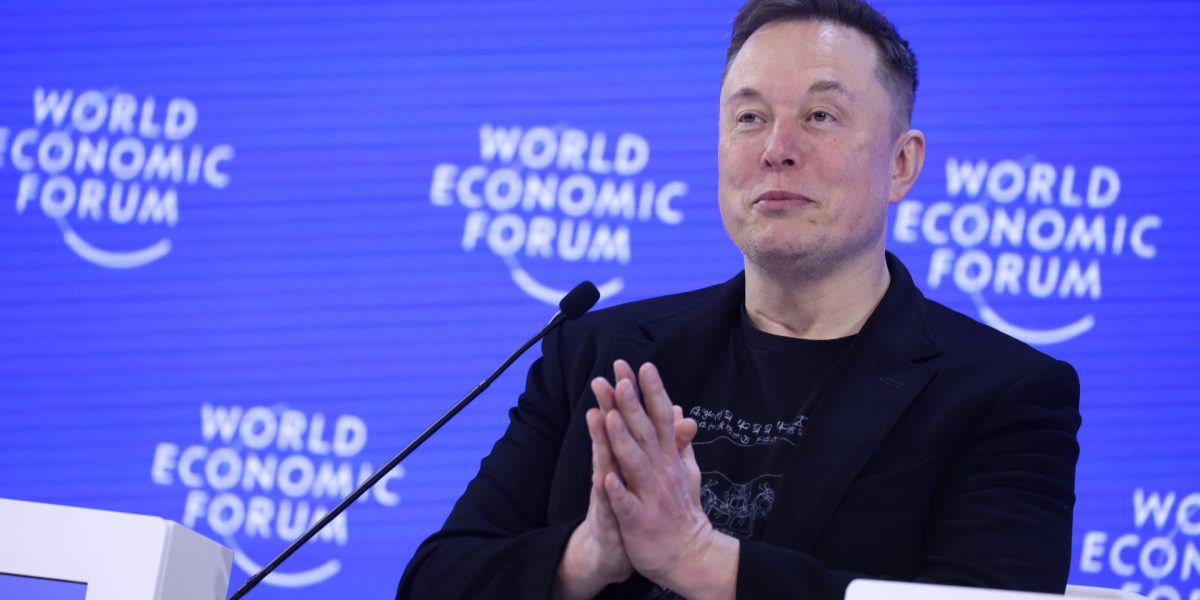
Despite Elon Musk’s multiple proclamations that he is an alien—something he reiterated on the stage of the World Economic Forum on Thursday—the billionaire SpaceX CEO thinks it’s very unlikely there is intelligent life beyond Earth.
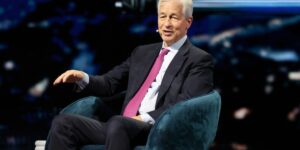
In a conversation in Davos, Switzerland, with BlackRock CEO and World Economic Forum interim chair Larry Fink, Musk said this belief is the framework of his technology ventures and $600 billion of wealth. Because there’s a small likelihood of life outside of Earth, Musk said the project of preserving humanity becomes more urgent.
I’m often asked, ‘Are there aliens among us?’ And I’ll say that I am one. They don’t believe me,” Musk said, unclear if he was joking or what particular point he was trying to make by asserting his alienness.
“Or you’re from the future,” Fink responded, alluding to previous times Musk has called himself a 3,000-year-old time-travelling vampire.
“The bottom line is, I think we need to assume that life and consciousness is extremely rare and it might only be us,” Musk added. “And if that’s the case, then we need to do everything possible to ensure that the light of consciousness is not extinguished.”
Musk’s vision of protecting humanity manifested more than a decade ago, when he founded OpenAI alongside Sam Altman in 2015 with the hopes of addressing the existential risks and safety concerns associated with the budding technology. He told Fink that Tesla and SpaceX, worth $1.4 trillion and $800 billion, respectively, were an extension of this belief, with the purpose not only to create sustainable technology, but “sustainable abundance.”
Musk’s vision for the future of humanity
Musk reiterated his vision of an abundance of humanoid robotics that would make work optional, claiming technology would ease the burden of humans to have jobs or even have money.
“With robotics and AI, this is really the path to abundance for all,” Musk said. “People often talk about solving global poverty, or essentially, how do we make everyone have a very high standard of living? I think the only way to do this is AI and robotics.”
The billionaire describes a world with billions of robots—which would outnumber humans—and would serve to complete tasks including caring for children and elderly parents. He predicted that there would be functional humanoid robot technology by the end of the year, and said he expected those robots to be retail available in the next couple of years.
To be sure, Tesla’s own Optimus robots have hit snags, continuously falling behind production schedule, with Musk saying as recently as Tuesday that manufacturing for the bots, as well as the Tesla Cybercab, would be “agonizingly slow” before production eventually ramped up.
Musk has previously said humans would be able to sustain themselves without work through a universal basic income, but did not provide details on the political steps needed to provide that income to humans.
These missions to preserve humanity extend beyond earth. Musk has described his goals as “Mars-shot,” alluding to his hopes to put human life on Mars, efforts he has even touched on in Tesla’s financial filings. The CEO has previously said he envisions Mars as an insurance policy for the future of humanity, wanting to use it as a jumping off point to expand resources to explore human consciousness.
“I’ve been asked a few times like, ‘Do I want to die on Mars?’” Musk said on Thursday. “And I’m like, ‘Yes, but just not on impact.’”
The Fermi Paradox, according to Musk
Musk’s philosophy regarding extraterrestrial life has previously engaged with the Fermi Paradox, a theory positing that there’s both a high change of intelligent life outside of earth—and scant evidence to prove it.
In 1950, Italian-American physicist Enrico Fermi, an architect of the atom bomb, asked a question in a conversation with colleagues at the Los Alamos National Laboratory in New Mexico: “Where is everybody?”
The three-word inquiry launched a 1963 paper by American astronomer Carl Sagan and proliferated in the scientific community, and the popularized Fermi Paradox soon emerged.
Musk said in an X post in 2023 that humans “are the only tiny candle of consciousness in an abyss of darkness.”
“The scariest answer to the Fermi Paradox is that there are no aliens at all,” he said.
In 2022, Musk even commissioned a sculpture depicting the “Fermi Great Filter,” a potential resolution to the Fermi Paradox hypothesizing that intelligent life must face and overcome a series of challenges, including the Great Filter which only few evolved species are able to overcome. The statue shows a giant fork with two diverging paths, indicating the choices a civilization must make to survive: a fork in the road, a motive Musk has oft drawn on.
Critiques of Musk’s philosophy
The high-stakes nature associated with Musk’s philosophy has drawn concern, with some arguing this effort to preserve humanity is actually threatening it. Rebecca Charbonneau, a historian at the American Institute of Physics, had a different interpretation of Musk’s philosophy as it pertained to work. In a piece published in Scientific American in February 2025, Charbonneau said Musk’s beliefs around preserving humanity reflected a bigger ideology in the world of tech.
Roots in vestiges of Cold War anxieties (the same time period in which the Fermi Paradox emerged), tech leaders often saw a false binary of either limitless prosperity or complete societal collapse, Charbonneau argued. As a result, many in the field, including Musk, are willing to go to extreme measures in the name of avoiding what they perceive as humanity’s demise.
“Proponents of this survivalist mindset see it as justifying particular programs of technological escalation at any cost, framing the future as a desperate race against catastrophe rather than a space for multiple thriving possibilities,” Charbonneau wrote.
She noted that Musk’s “Fork in the Road,” a strategy he employed both in culling staff at X and in the federal government as de facto leader of DOGE, was reflective of this. Musk called DOGE the “chainsaw of bureaucracy,” promising to shave $2 trillion in federal spending. Instead, the advisory eliminated about $150 billion in spending through headcount reductions and contract cancellations. Federal workers said the cuts made their jobs harder, eliminating valuable resources that resulted in their jobs taking longer, with the quality of the government’s work suffering.
Charbonneau argued Musk’s philosophy eliminates opportunities for nuance, making institutions—and humanity—vulnerable to often extreme responses to delicate situations.
“By framing humanity’s challenges as simple engineering problems rather than complex systemic ones, technologists position themselves as decisive architects of our future, crafting grand visions that sidestep the messier, necessary work of social, political and collaborative change,” she said.