Bryant attacks ‘irresponsible’ Stormont ministers over budget
The Northern Ireland secretary says there is “very little financial accountability or responsibility” across the executive.
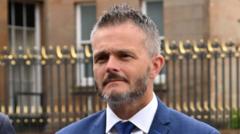

Northern Ireland Secretary Sir Chris Bryant has accused the Stormont executive of having little “financial accountability” while also ruling out “front-loading” extra money the UK government is proposing to give over the next three years.
The executive has not agreed a budget for this year, blaming the UK’s devolution funding formula for leaving it short.
Additional funding of about £1.5bn would be released in three tranches, with £525m available this year.
One idea being suggested is that a larger chunk of the money could be spent in the first year but Sir Chris told the BBC that was not on offer.
“There is no front-loading to be done,” he told BBC Radio Ulster’s Good Morning Ulster programme.
“I’ve made it absolutely clear about 17 times now, both to members of the executive and to others, that there is no additional money beyond the £525m we have set aside for this year.”
‘It’s irresponsible’
Bryant also criticised the performance of Stormont ministers.
“There is very little financial accountability or responsibility across the whole of the executive,” he said.
“That’s abnormal. There’s no local council anywhere in the UK that doesn’t have to bring in a balanced budget. That’s what the executive is going to have to do.”
He added: “You cannot keep overspending willy-nilly and not expect consequences from that. It’s just irresponsible.”
Bryant can ultimately impose a budget on the executive by legislating through Westminster.
He suggested the absolute deadline for that is the end of January 2027 when executive departments would run out of money under the emergency budget rules on which they are currently operating.
Executive ‘united’ on underfunding argument
Democratic Unionist Party (DUP) assembly member Trevor Clarke hit back at Sir Chris’s comments.
He argued that all ministers in the Stormont executive agreed that Northern Ireland was “underfunded” compared with Scotland and Wales.
“He can’t look at two different devolved regions where they are funded at a higher level than we are in Northern Ireland, with all of the problems we have,” he told the BBC’s Nolan Show.
“We’ve actually got a united executive which are all saying there’s insufficient funding to deliver the services that we require in Northern Ireland.”

People Before Profit (PBP) does not have representation on the executive but its assembly member Gerry Carroll also agreed that Stormont was underfunded.
“It’s time the secretary of state and the British government coughed up the money to make sure that we’re funded properly,” he told the Nolan Show.
“We’ve a situation where corporate wealth is through the roof in Britain and Ireland, and the fact that he’s telling people here that there’s no more money I think is a bit obscene.”
Carroll added that if Sir Chris’s argument was taken to its conclusion it “will mean services being cut, it will mean water charges, it will higher fees – which is the only plan that any British government have ever had for this place”.
“The executive are right in standing against those regressive measures.”
Budget row could lead to nurses’ strike
One of the consequences of failing to agree budget is that healthcare staff have yet to receive a pay rise this year, unlike their counterparts in the rest of the UK.
On Wednesday, the Royal College of Nursing (RCN) opened a ballot for industrial action, which may lead to nurses going out on strike over their delayed pay rise.
“It is despicable that, year after year, nursing staff in Northern Ireland are forced to fight for a pay award that colleagues elsewhere in the UK receive as a matter of course,” said Prof Rita Devlin of the RCN.
Health Minister Robbie Butler told the Nolan Show that it would be “unconscionable, unethical and immoral” if funding was not released for the pay rise.

Butler took over the job from Mike Nesbitt less than two months ago and has previously warned the pay issue could jeopardise recent progress on health reforms.
“We have huge problems that we’re trying to fix and sort out and unfortunately industrial action will set us back further,” Butler said.
“I impressed this upon my executive colleagues in the very first meeting that I had with them that any good work that has been made and any of the transformation that we have embarked on could be undone if industrial action isn’t avoided.
“And the only way we can avoid industrial action is to make the pay award.”
Asked what was holding up the release of funding, Butler said the failure to agree a Stormont budget “seems to be the primary obstacle”.
“Unfortunately with the political instability at the moment it’s hard to see that happening,” he added.

Social Democratic and Labour Party (SDLP) assembly member Matthew O’Toole, leader of the official opposition at Stormont, said public sector workers needed to know if they would receive their pay awards in time for Christmas.
He said the situation was reaching a “critical” point because it would eventually become “logistically impossible for payroll to be updated in time for Christmas wage packets”.
Speaking at the assembly’s finance committee, which he chairs, O’Toole called for an “urgent update” from the Department of Finance.
“Public sector workers out there rightly want to know whether they’re going to have their pay increase that they’re all expecting and deserve in time for Christmas.
“Both to meet the costs of Christmas, which is not getting any cheaper, but also the cost of increases at the pump and indeed increases in home heating oil and gas.”
O’Toole added: “The finance minister said on Monday he was taking legal advice on whether it was possible to agree public sector pay deals in the absence of an agreed executive budget. I think we need to know what that advice is.”
What money is available for Stormont?
Stormont departments are facing a shortfall of up to £1.6bn, according to a spending watchdog.
Last month, Bryant made an offer of a financial package worth about £1.5bn over the next three years.
But executive parties said that did not go far enough and they have argued that significant gaps remain before they can agree to a deal that would allow them to set a budget.
With no agreed budget, public services have been operating under contingency arrangements allowing departments to spend up to 95% of last year’s funding.