One Year Into Gaza’s So-Called Ceasefire, Palestinians Still Live Among Devastation
Palestinians in Gaza continue to deal with Israeli airstrikes, limited food and water, mass displacement and a humanitarian aid shortage.

Almost exactly one year after Israel reached a fragile ceasefire agreement with Hamas, Palestinians in Gaza continue to deal with the lingering effects of what human rights groups, United Nations experts and relevant scholars have all concluded is genocide — including Israeli airstrikes, limited food and water, mass displacement and a severe humanitarian aid shortage.
Israel currently controls about 70% of the strip, setting what’s been dubbed a “yellow line” that bars Palestinians from crossing. Since the ceasefire on Oct. 10, 2025, the Gaza Health Ministry has recorded more than 1,400 Palestinians killed and 4,880 injured.
Part of Israel’s control includes limiting access to humanitarian aid. According to the U.N., approved aid can only be brought into the strip via one crossing at the southern tip of the enclave. Humanitarian officials have been begging for Israel to allow more than the current sliver of aid to enter so that food, medical, hygiene and shelter needs can be met.
“A truck full of non-priority supplies or the right supplies arriving too late, doesn’t save lives. That’s the question that actually matters,” Dr. Reinhilde Van De Weerdt, the World Health Organization representative for Palestine, said last week.

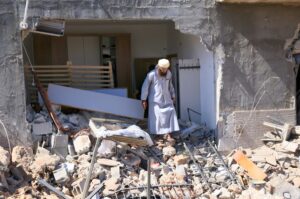
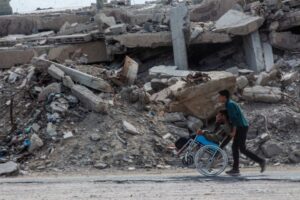
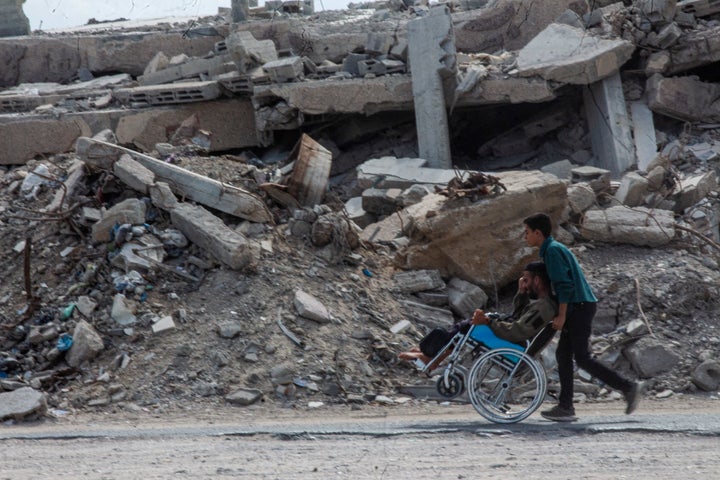
Palestinian face increased dangers because of housing instability after Israel essentially flattened the territory over the past three years. As of Sept. 20, the U.N. says that 94% of Gaza’s population remains in urgent need of shelter and basic household assistance. Israel has not allowed construction supplies in to help rebuild the homes, schools, hospitals and mosques reduced to rubble.
“As winter begins, this urgency to get supplies into Gaza only deepens,” Van De Weerdt said, warning of preventable disease outbreaks and rodents. “Almost two million people are in need of shelter to protect against the cold and the risk of flooding, exposing people to serious health and safety risks, let alone [their] dignity.”
In addition to shelter supplies, Israel is severely limiting the amount of food and supplies for meal production, fueling the ongoing hunger crisis facing Palestinians — particularly children, who require more sustenance for growth and disease prevention. U.N. personnel have previously described Israel blocking humanitarians from bringing in peanut butter as nutritional assistance for children, claiming it’s a “luxury” and that Hamas may steal it.
“It is insane, because on the other hand, they are allowing chocolates and they are allowing sugar into Gaza, but they do not allow something like peanut butter, which is nutritious,” Jaser AbuMousa, a Middle East Institute fellow from Gaza, told The New Yorker last month. “The U.N. was hoping that it would be helpful because of all the malnutrition that the people are suffering from. So their claim that it’s a luxury is nonsense.”

The lack of shelter and nutritious food has kept Palestinians susceptible to disease, made worse by a collapsed sewage network and a struggling hospital system with few medical supplies coming in.
“Most people have less than 1.5 gallons of water per day and limited access to basic hygiene items such as soap and detergent,” Dr. Murad Asaliyya, Gaza medical activities manager for Doctors Without Borders, said in a statement.
“We are treating gastroenteritis, acute respiratory infections, a lot of skin conditions, hepatitis, bacterial skin infections, scabies and lice,” Asaliyya continued. “At the same time, we are facing severe shortages in terms of medical supplies. Even the cream we need to treat scabies has been restricted by the Israeli authorities.”
Progress on the ceasefire agreement has been at a standstill as Israel continues attacking Gaza while severely limiting aid. The so-called Board of Peace created by the Trump administration has been given authority to oversee Gaza’s rebuilding, but the board’s representative recently argued that Israel’s ongoing strikes threaten the deal as well as any chance of Hamas disarming.
Speaking to The New Yorker, AbuMousa said that the lack of progress means daily life for Gazans has felt like a tense waiting game.
“The tone is completely desperate, to be honest. I mean, the waiting without anything moving is making people angry, and they cannot respond positively,” he said. “I mean, they cannot engage in a normal conversation. I understand this. I totally understand this.”