Fed chair contender Christopher Waller says weak jobs data is strengthening the case for more rate cuts: ‘AI is stalling hiring’
Also: All the news and watercooler chat from Fortune.
Good morning. I was at the Yale CEO Summit yesterday in New York, hosted by Jeffrey Sonnenfeld, senior associate dean of the Yale School of Management and longtime Fortune contributor. Much of the conversation focused on navigating a volatile business landscape and an administration that gets laurels for its pro-business policies and darts for how it deals with allies and anyone who speaks out against Trump or his policies. As always, Sonnenfeld kept it off the record to, as he put it, “tap into problem-solving instead of name-calling” and let divisive issues “be discussed constructively, free of grandstanding, ideological clichés, and tribal loyalty.”
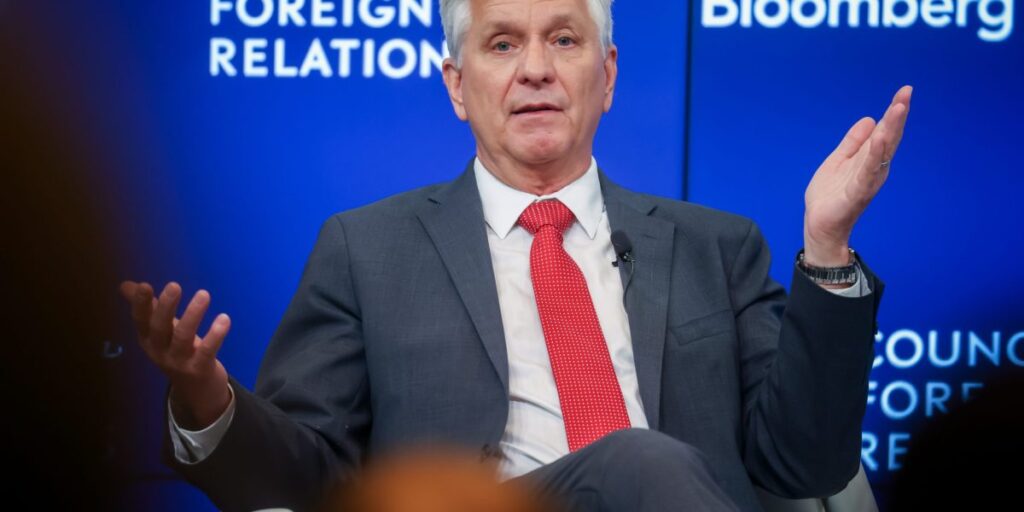
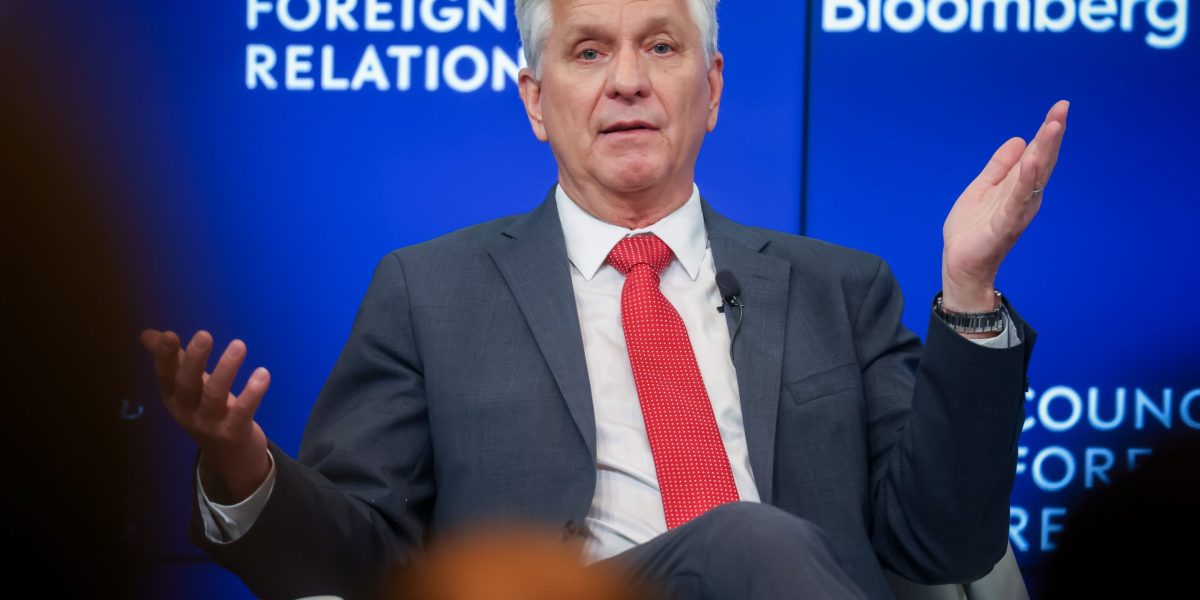
What was on the record: a conversation between CNBC’s Steve Liesman and Fed governor Christopher Waller, a contender to replace Jerome Powell as chairman of the Federal Reserve, alongside frontrunners Kevin Warsh and Kevin Hassett. (In a spot poll, 81% of people in the room supported Waller taking the role, but just 36% predicted he would get the job.)
The conversation came at a time of weak job data and growing speculation about rate cuts, along with data showing a K-shaped economy in which wealthy Americans feel flush while their poorer brethren struggle with higher prices and slower wage growth. (The Fed cut rates for a third straight meeting earlier this month to support a softening labor market.)
Some of Waller’s comments that stood out for me:
On future rate cuts: “We’re still about 50 to 100 basis points above neutral,” said Waller, who argued for a rate closer to 3%. “We’re close to zero job growth. That’s not a healthy job market. AI is stalling hiring; there’s not going to be any reacceleration of inflation.” That said, “because inflation is still up, we can take time to steadily bring the rate down towards neutral.”
On central bank independence: “If there’s something pressing, I know in the past, Fed chairs have talked to the president. COVID is an example where you wanted a coordinated response. The Fed chair and the secretary of Treasury have breakfast every two weeks; that’s a typical channel of communication. I spent 20 years of my life working on central bank independence. The other side is accountability: We want central bank independence, but we still want to be accountable to the American public.”
On the growth outlook: Waller estimates 1.6% growth for 2025, largely due to a negative first quarter. He predicts a stronger picture for 2026, where “there will be some stimulus effects, productivity effects, a waning of tariff effects [which he thinks will settle at a 10-11% effective rate]. All of that is pro-growth, pro-U.S., inflation easing.”
On stablecoins: “If you want competition in the payment space, go to stablecoins. These are very fast and efficient ways to move money across the globe. I want an even playing field… We have to get off this crypto-is-an-evil-thing mentality; you have to understand all these technologies … This is going to strengthen the U.S. dollar.”
Contact CEO Daily via Diane Brady at [email protected]
Top news
BP hires Big Oil’s first female CEO
Embattled BP named a new chief executive Wednesday: Woodside Energy chief executive Meg O’Neill will take over the role in April, making her the first woman to lead a Big Oil giant. BP is in turnaround mode and looking to recover from the abrupt 2023 departure of ex-CEO Bernard Looney and this year’s rumors that it was a Shell acquisition target.
The Oscars go to … YouTube
The Academy of Motion Picture Arts and Sciences has granted YouTube exclusive global streaming rights to the Oscars from 2029 through 2033, ending a five-decade partnership with ABC and “fundamentally altering how Hollywood honors itself,” Fortune’s Dave Smith reports. YouTube’s global viewer base of 2 billion is at the core of the Academy’s decision as it tries to rebuild its audience that totalled 19.7 million this year, down from a peak of 55 million in 1998.
Amazon’s AGI head to leave, $10 billion deal with OpenAI in talks
Amazon CEO Andy Jassy announced that the company’s artificial general intelligence head Rohit Prasad is stepping down at the end of the year as concerns about the competitiveness of the company’s AI operations continue to mount. Meanwhile, The Information reported this week that Amazon is in talks to invest $10 billion in OpenAI. Analysts who spoke to Fortune say the investment is another example of “circular” money transferring between large AI players.
China’s youth seeks government jobs
Nearly 4 million Chinese took the country’s civil service exam last month, a record, as job prospects for new college graduates remain dim. Only one in 100 applicants will secure a public sector position, but job-seekers took those odds with unemployment among 16- to 24-year-old urbanites stuck at 17% (versus 10% in the U.S.).
Taiwan arms sales
The U.S. has sold $11.1 billion worth of arms to Taiwan, the biggest package of its kind, as the island readies itself for a potential conflict with mainland China. The deal threatens to chill newly-thawed tensions between Washington and Beijing.
Trump’s oil sanction threats
This week, President Donald Trump declared a blockade of “all sanctioned oil tankers going into, and out of, Venezuela.” Analysts argue that, if the blockade extends past already-sanctioned vessels, it would be “devastating” to Venezuela’s struggling economy.
The markets
S&P 500 futures are up 0.41% this morning. The last session closed down 1.16%. STOXX Europe 600 was up 0.29% in early trading. The U.K.’s FTSE 100 was up 0.18% in early trading. Japan’s Nikkei 225 was down 1.03%. China’s CSI 300 was down 0.59%. The South Korea KOSPI was down 1.53%. India’s NIFTY 50 was flat. Bitcoin was steady at $87K.
Around the watercooler
Exclusive: Hudson stores operator Avolta becomes first foreign company to open duty-free shops in Mainland China in 26 years by Peter Vanham
Netflix co-CEO faces the $100 billion question: ‘Why are you doing this deal?’ by Nick Lichtenberg
Gen Z’s reality check: Birkin resale prices slump as aspirational luxury takes a hit by Sasha Rogelberg
Sheryl Sandberg says Silicon Valley’s hyper-masculine rhetoric is ‘terrible’—contributing to ‘one of the worst’ corporate climates she’s ever seen by Marco Quiroz-Gutierrez
CEO Daily is compiled and edited by Joey Abrams, Claire Zillman and Lee Clifford.